Screenplay Evaluation · File CW-001
Chinatown
| Date | January 5, 2025 |
|---|---|
| Project | Chinatown |
| Writer | Robert Towne |
| Genre | Period Crime / Mystery |
| Budget | High (Period Reconstruction) |
| Station | PASS |
Logline
In 1930s Los Angeles, a private investigator specializing in matrimonial tracking is drawn into a complex web of municipal corruption and murder after taking a fraudulent case involving the city's water commissioner.
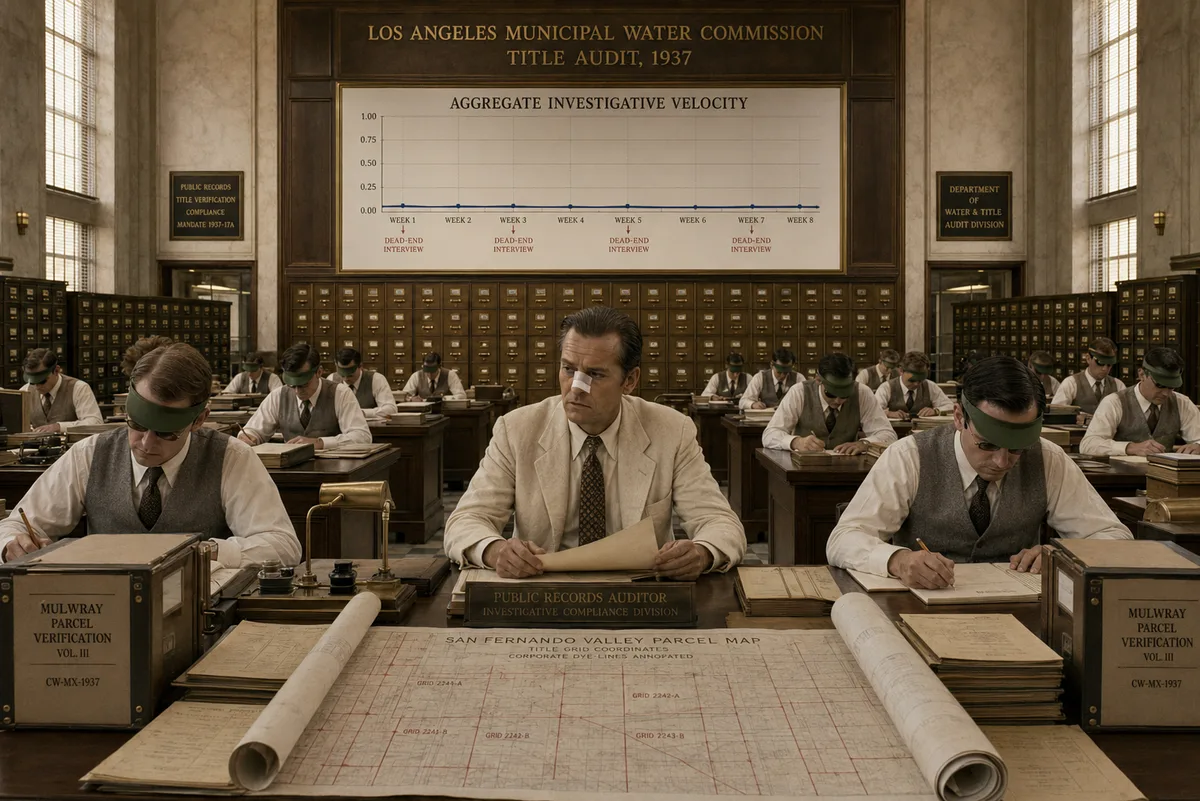
Screening Metrics — 1-10 Gauntlet
| Metric | Score | Reader Note | |
|---|---|---|---|
| Concept / Hook | 6.5 | Standard hard-boiled detective setup; highly derivative of classic noir pulp | |
| Pacing | 3.5 | Unusually slow; narrative engine gets bogged down in administrative procedures | |
| Dialogue Economy | 4.5 | Period-accurate phrasing carries some flavor, but conversational blocks lack compression | |
| Character Logic | 6.0 | Protagonist behaves realistically within his trade, though his lack of basic verification in Act I strains credibility | |
| Commercial Viability | 4.0 | High cost of period-accurate set construction vs. a niche, low-velocity mystery market |
Mandatory Redlines
- Compress the Investigation. Cut the land registry, orange grove, and public archive sequences down by 60%. Merge these data-gathering scenes into a single, visually propulsive montage to restore narrative velocity.
- Accelerate the Inciting Incident. Move Hollis Mulwray's death to page 12. Eliminate the extended tailing sequences in Act I so the detective is thrust into a high-stakes murder investigation immediately.
- Restructure the Climax. Rewrite the ending to ensure Noah Cross faces legal or physical consequences for his actions. J.J. Gittes must take an active role in resolving the conflict rather than standing by as a helpless observer in the final frame.
Overall Score
File CW-001 · Chinatown
Station: Pass
4.0
Expert Development Analysis
1.The Page 10 Exclusion Zone
A primary reader will struggle to find a definitive commercial hook in the opening ten pages. The script dedicates excessive real estate to establishing J.J. Gittes' domestic private eye practice — showing him taking mundane photos of cheating spouses and trading jokes with his operatives. While this establishes a specific tone, the central mystery does not truly engage until much too late. The target of the investigation, Hollis Mulwray, spends his early scenes examining dry riverbeds and attending municipal water hearings. For a theatrical feature thriller, tracking the daily logistical routines of a public utility department creates an immediate deficit in narrative momentum. If the physical danger or the central crime is not initiated by page 12, the project will be passed on by standard coverage units as a structural dead-end.
2.Narrative Inefficiencies and Procedural Slog
The second act is heavily waterlogged by its own investigative data. The protagonist spends multiple, consecutive sequences performing administrative research — driving across the valley to look at orange groves, examining public land registries, and verifying property titles. While the writer demonstrates a thorough understanding of historical Los Angeles water infrastructure, these procedural steps are fundamentally anti-cinematic. Drama requires dynamic, action-driven characterization. Sitting in a county records office reading deeds across four pages of text halts the film's kinetic pulse.
Additionally, the dialogue between Gittes and Evelyn Mulwray frequently dances around subtext to an exhausting degree, utilizing conversational riddles and polite period formalities when the stakes demand concise, high-pressure information exchange.
3.Act III Demographics and Resolution Failure
The script's ending represents a severe commercial liability. Allowing the primary antagonist, Noah Cross, to successfully execute his corrupt municipal takeover, secure the land profits, and escape accountability entirely provides zero emotional satisfaction for the audience. Furthermore, the abrupt, bleak termination of the female lead's arc in an alleyway leaves the protagonist entirely defeated and passive as the credits roll. In the current market, audiences demand clear narrative resolution and a definitive triumph of the protagonist over the central antagonist. Ending a major theatrical investment on a note of total systemic futility ensures poor word-of-mouth and severely compromises the project's box office potential.