Nora Ephron
The Architecture of the Contrived Separation — distance gimmicks, near-misses, and the deficit of contact.
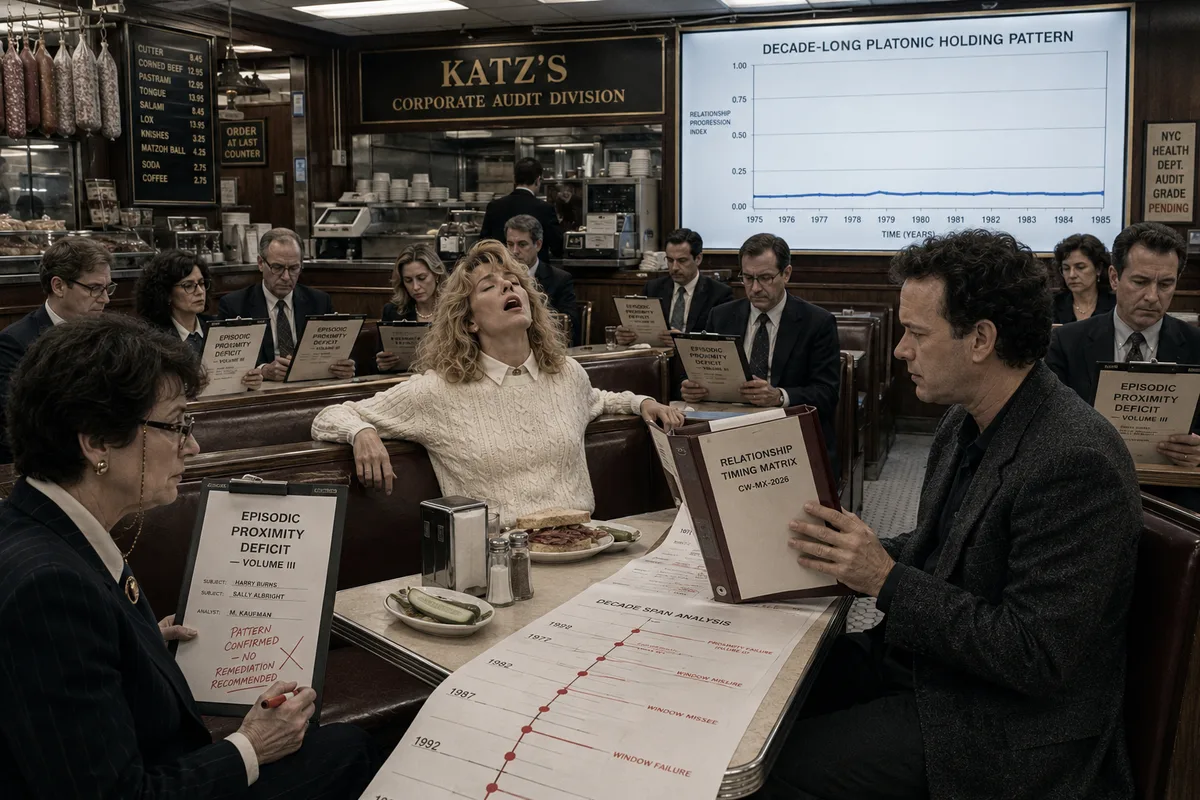
Primary System Defects
- Contrived Narrative Bottlenecks
- Episodic Passivity
- Low-Stakes Melodrama
The Modern Reality
Mainstream four-quadrant demographics require high-stakes physical urgency or intense psychological friction. Ephron's structural layout relies entirely on highly convenient, writer-engineered gimmicks to keep her romantic leads separated until the final five pages of the script.
The Core Defect Analysis
The commercial viability of mainstream romantic cinema is fundamentally predicated on the generation of high-stakes psychological friction and immediate human interaction — a baseline metric that the screenplays of Nora Ephron systematically compromise. While acknowledging her monumental status as an industry pioneer and her undeniable, multi-million dollar box office leverage, a contemporary structural audit reveals significant operational liabilities within her texts. Ephron's legacy is inextricably bound to a highly specific, late-twentieth-century studio environment that indulged extensive, passive physical distance between leads.
When Harry Met Sally showcases exceptional behavioral wit and remains a gold standard for conversational chemistry, but Sleepless in Seattle represents a severe structural liability under modern analytical review. The primary system defect in Ephron's narrative geometry is the intentional, prolonged isolation of the romantic pairing across the entire second act. In a standard, high-margin four-quadrant property, the two leads must be placed in immediate proximity by Page 25 to establish an active, behavioral baseline of conflict. Ephron explicitly subverts this necessity. The text keeps the protagonists, Sam and Annie, separated by entire geographic regions for 95% of the runtime.
Because the characters are restricted from engaging in real-time, face-to-face verbal maneuvering, the script experiences an immediate velocity deficit. The narrative engine is forced to operate via proxy phone calls, radio monitoring, and secondary long-distance observation, stalling the development of genuine interpersonal subtext. This structural paralysis requires the continuous deployment of highly artificial, writer-engineered near-misses to simulate dramatic tension. Throughout Act II of Sleepless in Seattle, the text resorts to a series of logistical anomalies — such as a dropped teddy bear at a crowded airport terminal or an unverified letter crossing paths in an office matrix — to manufacture a sense of cosmic inevitability:
From an operational development standpoint, this heavy reliance on circumstantial destiny acts as an uncompressed crutch, substituting passive, coincidental timing for active, self-directed character agency.
Furthermore, this distance-based layout flattens the script's kinetic pulse by forcing the characters into prolonged cycles of internal reflection and secondary discussion. Rather than utilizing dialogue to achieve immediate, tactical micro-goals against one another, the leads spend consecutive pages sitting in separate rooms explaining their romantic philosophies to third-party confidants. This configuration fractures the text into two isolated, independent biographical tracks that must be continuously cross-cut, inflating the page count with unmarketable verbal noise. The audience is essentially asked to read two separate movies simultaneously, waiting for a definitive convergence that is artificially withheld until the final five pages of the script.
The Mandatory Redline
The Fix. Eliminate all passive, distance-based romantic separation devices. The modern war for attention cannot survive a narrative engine built on a literal deficit of contact.
The Redline. In Sleepless in Seattle, force the two leads into the same physical environment by Page 20. Re-stage the script as a fast-paced, high-stakes corporate real estate or architectural asset acquisition battle where they are direct adversarial competitors fighting over the same Pacific Northwest shoreline property, forcing genuine, high-pressure human interaction over artificial radio nostalgia.